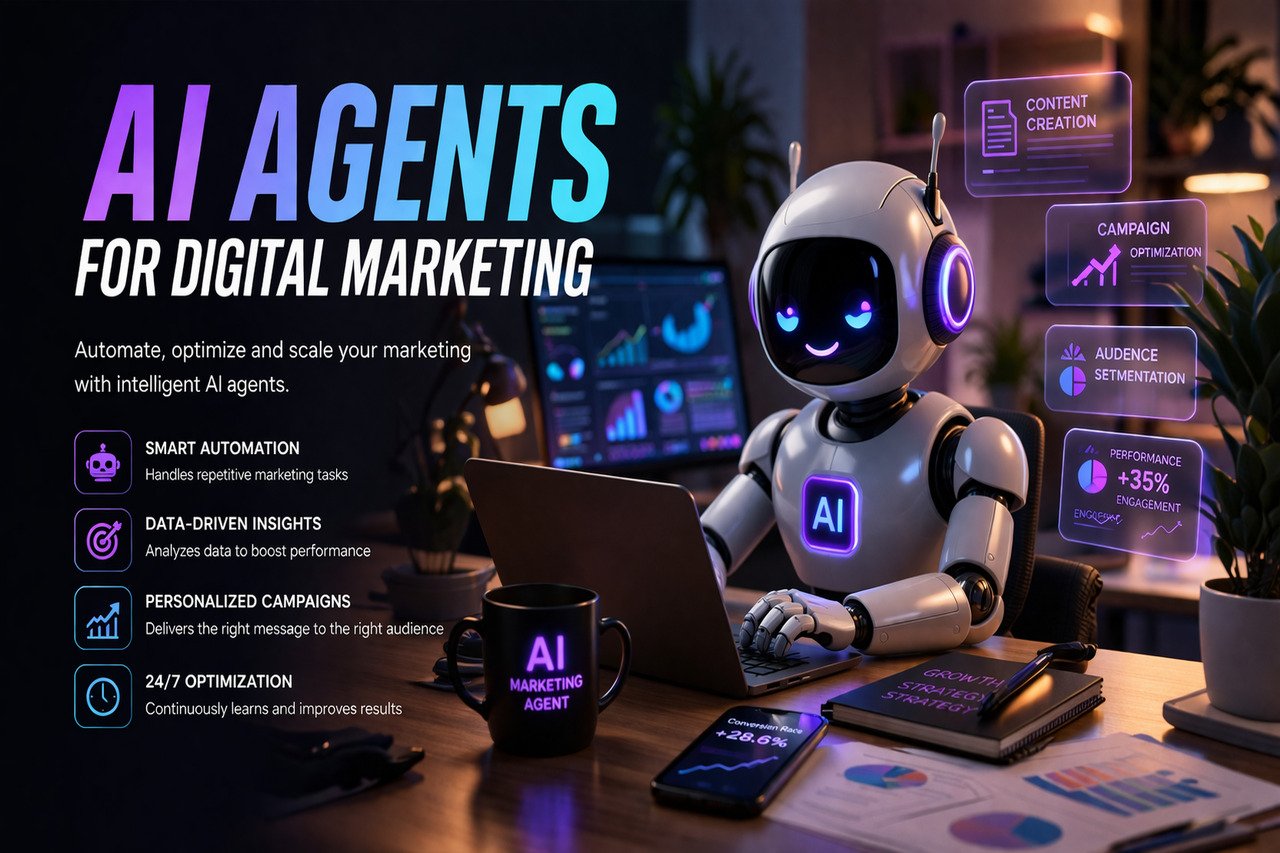
AI agents for digital marketing assist brands in running advertisements, monitoring users, and modifying content according to trends. These tools leverage data to discover what works, save time, and reduce human errors.
Your teams use AI agents to try out new ideas, dispatch personalized emails, and detect trends quickly. For marketers, AI agents provide a new direct avenue to deliver to users across multiple platforms.
The second half will demonstrate how they function in actual tasks.
Key Takeaways
-
AI agents are revolutionizing digital marketing by automating menial tasks, making independent decisions, and generating interconnected systems. This increases efficiency and allows humans to focus on strategy.
-
These advanced solutions go beyond automation to provide intelligent insights, foster creativity, and deliver personalized customer experiences through sophisticated data analysis.
-
To get the most out of your AI, organizations should align their AI initiatives with defined business goals, leverage predictive analytics, and constantly monitor and optimize agent performance through feedback loops and adaptive learning.
-
Easy integration of AI agents with existing marketing tools and workflows encompasses guaranteeing data quality, facilitating human-AI collaboration, and upholding compliance with data privacy and ethical standards.
-
Real world applications of AI in marketing are social media optimization, ad campaign automation, personalized customer journey mapping, and content strategy improvement to generate quantifiable engagement and efficiency improvements.
-
Continuous AI impact measurement, ethical supervision, operational transparency, and perpetual marketer upskilling remain key for sustainable and responsible AI-powered marketing success.
The Agentic Shift
AI agents are transforming digital marketing by making it more efficient. Teams already use these tools to reduce low-level work so that humans can spend more time strategizing and less time doing grunt work. AI agents introduce novel methods to make decisions in campaigns, leveraging data to take initiative and optimize outcomes.
When more tightly integrated, these systems help create a well-connected marketing ecosystem that operates in real time.
1. Beyond Automation
Old automation had to follow a path. AI agents take it even further. They leverage data to identify trends, uncover new customer segments, and proactively recommend modifications.
AI agents can sift feedback and adjust ads or emails with no human intervention. They even assist brands in speaking to every individual in a personal, not generic manner, as they analyze what every user loves or does.
This shift allows teams to experiment, iterate quickly, and optimize campaigns.
2. Autonomous Goals
Prior to employing AI agents, teams need to establish objectives that align with the business’s desires. AI can leverage data to predict what will be most effective.
These agents observe campaign performance, identify vulnerabilities, and address them. Feedback loops are crucial. They allow AI to learn from what succeeds and what fails, so outcomes improve over time.
3. Continuous Learning
Machine learning makes AI agents keep getting better. They refresh their work by observing new data and market shifts.
Old customer data helps them make smarter calls. This allows teams the freedom to experiment with new strategies without major liabilities.
4. Proactive Execution
AI agents can identify emerging trends before they become popular. They blast new stuff or offers on their own, according to what they discover.
Quick reaction keeps brands in front, but crews still monitor for the season on track.
5. System Integration
AI agents need to play nice with the tools teams use. APIs help tie things together, so it’s all in one place.
This smooths out work and allows humans and AI to collaborate, not compete.
Strategic Integration
Strategic integration is about deploying AI agents within a digital marketing stack in a manner that aligns with the company’s key objectives. This allows brands to integrate third-party apps, such as CRM solutions, to expand what the AI agents are capable of. It keeps things loose.
Teams, despite having fewer people, could plan and run large-scale campaigns. AI agents assist in automating intricate tasks, enhancing customer interactions, and streamlining workflows. They can simultaneously manage thousands of little, crucial decisions, like message testing or adjusting ad targeting.
This does not imply recruiting additional personnel. AI can operate content creation and content distribution and even measure performance—all simultaneously. For some, this has led to big jumps in efficiency, as much as 76% in e-commerce. Companies can create hundreds of iterations of content, experiment, and tweak things based on what catches hold. All this is achieved with less hands-on effort.
Phased Adoption
To keep teams humming, you need to roll out AI agents gradually. Each stage should be evaluated for effectiveness and then applied to optimize subsequent steps. Training isn’t a one-time event; it’s perpetual.
Employees must learn how to collaborate with new AI tools, so things don’t come to a halt. Taking team feedback on what works and what doesn’t helps identify where things break or bog down, and your process can be adjusted accordingly.
Workflow Redesign
Marketing workflows require a facelift to accommodate AI. Begin by identifying areas where AI can automate tasks or accelerate processes, such as lead segmentation or outreach. Normal means for AI to play its part maintain everything running the same each time.
You want humans and AI to collaborate, not just coexist, in creating these new workflows. That way, everyone is clear on their responsibility.
Data Readiness
-
Audit data sources for completeness and accuracy
-
Ensure access rights for AI tools are in place
-
Regularly clean and update data sets
-
Use secure storage and backup practices
-
Monitor compliance with data protection laws
Good data is a must for AI strategic integration. Analytics help spot patterns and guide what AI should do next. Having clear boundaries for data ensures it stays secure and compliant.
Human-Agent Synergy
Human-agent synergy in digital marketing is about mixing human expertise with AI agent strength. This way, both sides are free to focus on what they do best, resulting in more intelligent and flexible work. Teams can attain objectives quicker and more sharply, not just complete low hanging fruit.
By sharing tasks and knowledge, agents automate routine steps, and humans handle challenging or ambiguous problems. The resulting blend reduces expenses by as much as 30 percent and increases process velocity by up to 50 percent. There are more opportunities than ever to leverage agents capable of managing multiple modalities of input—text, voice, image, or video.
These agents are becoming more autonomous and capable of making significant decisions, but humans still steer crucial phases and provide context.
Checklist for Human Oversight in AI-Driven Marketing:
-
Periodically examine agent activities and outcomes for bias or errors.
-
Set clear rules for when people must step in.
-
Train team members on both AI strengths and limits.
-
Encourage team feedback about agent outcomes and use cases.
-
Update oversight as agents and market needs change.
Redefining Roles
Marketers now have to recalculate their position in the digital ecosystem. With AI, a lot of old tasks shift or disappear, but new ones emerge. Humans might leverage AIs to verify trends, inform stronger campaigns, or experiment at scale.
Skill growth is key; teams have to learn how tools work and how to use them with a keen eye. Remaining nimble as roles evolve is now the role.
Fostering Trust
Trust in AI arises from transparency in how it functions and why it makes every decision. Teams ought to understand what agents do and be confident using them. Feedback is good; solicit it regularly and adjust tools accordingly.
Concrete proof of success helps teams view AI as a powerful collaborator.
Creative Oversight
Humans have to remain in control of what feels right and what looks right. AI can produce hundreds of content types, but humans choose which ones fit the brand. Collaborating, AI adds velocity and humans add vitality.
Review rules maintain quality so that only the best work goes live.
Practical Applications
AI agents have the potential to shift how marketing teams strategize, construct, and optimize campaigns. Designed for practical applications, these tools integrate into CRMs, CDPs, and cloud tools, enabling teams to move faster, experiment with new ideas, and engage with millions of customers simultaneously.
By 2025, 85% of enterprises intend to deploy AI agents to enhance customer experience and work processes.
Social Media
-
Teams use AI agents to draft, schedule, and post updates across networks, saving hours a week.
-
Social listening tools monitor audience sentiment and identify emerging trends. AI connects mentions and hashtags to customer interests, which enables brands to respond quickly.
-
AI does ad targeting by tracking clicks, likes, and shares to determine who sees what and when.
-
These tools monitor campaign performance, link content to sales, and identify the concepts that perform most effectively.
Content Strategy
AI content agents compose blogs, emails, and ad copy. They can test out hundreds of versions, then see which ones have the highest number of clicks or shares. Teams utilize this information to strategize the next play.
With predictive analytics, marketers know which topics or formats might catch on next month. AI-assisted insights help teams choose topics, tone, and timing, making everything more likely to resonate. These tools keep your content plan fresh and on target.
Ad Campaigns
AI automates ad bidding, budget tweaks, and timing on the fly. Predictive models detect who will likely click or purchase, optimizing each campaign. Real-time dashboards enable teams to adjust strategy the second results fall.
AI tools recommend new images or taglines for higher performance, allowing marketers to do more tests in less time.
Customer Journeys
AI maps out how visitors move from first click to loyal customer. Agents automate replies to questions, send personalized offers, or trigger re-engagement emails after long silences.
By monitoring signals such as page visits or event registrations, AI discovers the optimal timing to contact. These tools assist teams in constructing a more personal, useful journey for each individual user.
Measuring True Impact
Measuring the real impact of AI agents in digital marketing requires monitoring both metrics and actual user reactions. Numbers don’t tell us how AI transforms work for marketing teams or clients. Qualitative feedback is as critical as hard data.
Collecting qualitative feedback from users can reveal nuanced changes in workflow and satisfaction that metrics might overlook. Bullet points below help organize feedback:
-
Query team members about how AI tools changed their daily work habits.
-
Gather customer feedback on timeliness and service.
-
Log issues or complaints that arise since AI adoption.
-
Notice any innovative requests generated by AI-automated processes.
Performance tracking needs analytics that record, track, and analyze every touch and conversion. Evaluate ROI for each AI-enabled campaign, then compare it to the pre-AI baseline. Systems should tie back to marketing objectives, so outcomes are both transparent and significant.
Engagement Metrics
Analytics software monitors user engagement with content, response times and satisfaction ratings. Conversion rates, which indicate how many users are taking these actions, help you gauge how successful your campaign is.
By monitoring these trends monthly, teams detect what’s working and tweak future plans.
Efficiency Gains
Automated tools take care of the boring work faster. This liberates teams to do creative or high-level work. Less manual work leads to fewer mistakes and less burnout, which drives team productivity higher.
By contrasting saved hours and output gains, you can better rationalize spending more on AI.
Strategic Alignment
AI projects ought to align with the entire marketing strategy, not merely technical objectives. Use OKRs or balanced scorecards to keep work on track.
Review AI results each quarter to ensure they are contributing to achieving sales or brand objectives. Monthly check-ins between marketing leads and upper management keep teams aligned and ensure investments pay off.
Ethical Guardrails
Ethical guardrails are essential for AI agents in digital marketing to prevent manipulation, preserve customer trust, and comply with laws. Ethical guardrails dictate agents’ behavior so they adhere to ethics and regulations. These guardrails reduce the likelihood of duplicitous behavior, such as concealing information or employing weasel words in marketing.
The EU AI Act and NIST’s AI Risk Management Framework establish firm guidelines for AI deployment, emphasizing fairness and transparency. Brands can benchmark complaint rate per 10,000 impressions or average time to takedown to see if those ethical guardrails actually work. Trust is brittle in digital realms; a single stumble can do permanent damage and be far more expensive than continuous preventive care.
Data Privacy
Businesses must implement firm data privacy protocols to protect user information. These guidelines should align with legal standards like the EU AI Act, which establishes a strong privacy standard in digital marketing. Data encryption and secure storage tools are not optional; they are essential to preventing leaks and breaches that can result in severe fines and reputational harm.
Training for all staff on best ways to handle data is vital. When teams know what to do, they screw up less and catch risks more quickly. Complying with privacy regulations in all regions is difficult, but it’s required. The goal is simple: keep customer data safe and maintain their trust.
Transparency
AI for marketing will not work behind a black box but in plain sight. Customers need to be aware of what data is being utilized and its purpose. Brands, for example, can establish obvious reporting mechanisms that illustrate how AI determines content or advertisements.
Open conversations with clients foster trust. Sharing simple details, like why a user is seeing a particular ad, can de-escalate grumbling and demonstrate respect. Stakeholder feedback is essential. It injects fresh perspective and can identify problems early.
Accountability
Clear accountability is essential when AI powers marketing. That means teams must be clear on who reviews AI output and flags issues. Regular audits, checking up on AI behavior and decisions, identify errors and correct them before they do damage.
Businesses need to establish product liability guidelines. When AI wrecks, there must be real consequences. This forces teams to verify their efforts and comply. An ethical guardrails culture in which everyone takes responsibility reduces the likelihood that minor mistakes escalate to major issues.
Conclusion
AI-powered tools are now influencing digital marketing in ways that seem downright direct. Teams deploy these agents to sift leads, refine ads, and verify actual outcomes. The pivot yields obvious victories: more precise targeting, quicker response, and less hunch-based decisions. Marketers now dedicate more hours to strategic objectives and fewer to legacy tasks. Human skill remains central. Agents assist, but humans provide direction and make decisions. Good use implies constant monitoring and truthful statistics. Teams that combine tech with human talent experience sustainable improvements. To keep pace, discover what agents can do and identify emerging trends early. Pass it around the industry. To thrive, be curious, experiment with every new tool, and cultivate a tribe that learns together.
Frequently Asked Questions
What are AI agents in digital marketing?
AI agents are software tools that automate and optimize marketing tasks. They employ AI to process data, orchestrate campaigns, and provide tailored content in bulk.
How do AI agents support marketing strategies?
AI agents assist marketers in making data-driven decisions. They find trends, target the audience, and automate the grunt work, making your strategies smarter.
Can AI agents work alongside human marketers?
Yes, AI agents augment human creativity by doing the grind work. This collaboration enables marketers to concentrate on strategy, creativity and connecting with consumers.
What are practical uses of AI agents in digital marketing?
AI agents can automate email campaigns, consumer analysis, social media, and ad budgets. These applications enhance productivity and boost outcomes.
How can I measure the impact of AI agents in my marketing?
Monitor KPIs, including engagement, conversion rates, and ROI. Here’s what these metrics demonstrate about AI agents for digital marketing.
Are there ethical concerns with using AI agents in marketing?
Yes, significant issues are data privacy, transparency, and preventing bias. Marketers need to be responsible and ethical with AI to foster trust.
What steps should I take to integrate AI agents into my marketing?
Work backwards, beginning with tasks that AI can automate. Pick trusted AIs, train them right, track results, and iterate.