
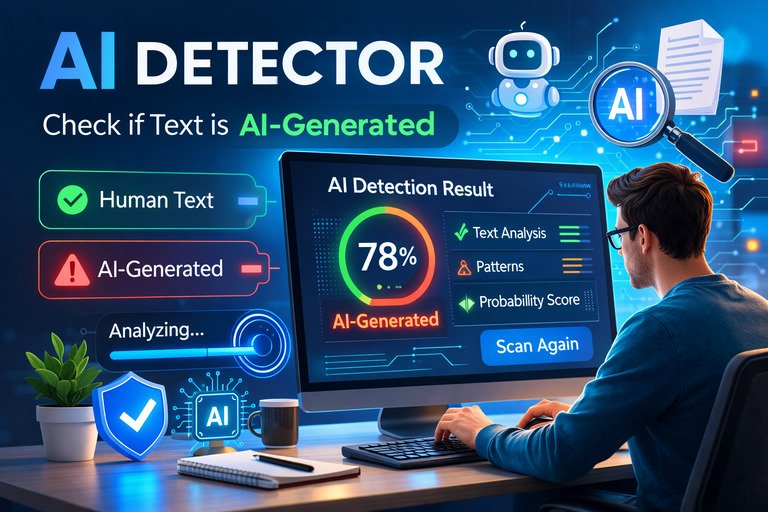
AI detector is designed to identify whether a text or image was created by AI. AI detectors analyze patterns, vocabulary, and other indicators to determine whether AI generated the text.
Thousands of enterprises, academics, and publications employ such instruments in order to assist verify integrity and maintain confidence. Understanding how these tools work can help people use them correctly.
The following section will discuss more about the primary varieties and their applications.
Key Takeaways
-
AI detection tools use statistical analysis, linguistic fingerprints, and measures such as perplexity and burstiness to identify AI-generated content, offering a data-driven approach to content verification.
-
Combining state-of-the-art machine learning classifiers and watermarking techniques detects AI across text and media.
-
Real-world use cases of AI detection include education, cybersecurity, and content moderation, assisting organizations in enforcing norms, safeguarding confidential data, and fostering responsible digital environments.
-
It’s not easy to really detect AI accurately because of false positives and false negatives. The algorithms need to be continually improved with feedback.
-
Ethical concerns, such as algorithmic bias and the human toll of automation, require transparent development and conscientious deployment of AI detection tools to prevent adverse outcomes.
-
The future of AI detection lies in continued research, adaptable technologies, and a thoughtful mix of AI and human involvement to keep it fair and effective across different cultures and languages.
The Core Mechanism
AI detectors operate by identifying patterns, structure, and predictability in text. They rely on machine learning models trained on massive volumes of human and AI-generated text. Their central activity is identifying clues that suggest if a text is authored by a human or an AI.
This involves examining the structure of the language, the rhythm of sentences, and the level of randomness or predictability of the writing. Here, metrics such as perplexity and burstiness are a core mechanism. Detection tools’ accuracy varies widely, between 60 percent and more than 90 percent, depending on the underlying data and the tool’s design.
For worldwide users, these distinctions are important as language, editing, and culture all factor in.
1. Statistical Analysis
Something like statistical methods are the backbone for most AI detectors. By performing statistical analyses on a chunk of text, these tools determine the probability of being AI-generated. For example, a detector might examine the frequency of particular words, the distribution of sentence lengths, or recurrences of phrases.
These patterns tend to be distinct when compared with human text. Data-centric techniques increase the detection tools’ sensitivity, so they can take note of nuances that might elude others. By comparing the statistical results from multiple models, you can see which tool performs best for specific languages or writing styles.
Visualizations, such as histograms and scatter plots, make these discoveries more accessible, allowing even less technical users to see what’s happening.
2. Linguistic Fingerprints
Human writers incorporate mixed sentence lengths, colloquialisms, and regional language. AI outputs are more mechanical and formulaic. Algorithms can rank these discrepancies based on grammar, vocabulary, and style.
Human writing tends to be more error-prone and takes more stylistic gambles, while AI tends to follow more conservative templates. These fingerprints comprise strange repetition, absent nuance, or clunky transitions. All of these can indicate content created by a machine.
When these fingerprints are mapped, detectors can flag suspicious text and provide a better view of who or what wrote it.
3. Perplexity and Burstiness
As a rough explanation, perplexity measures how complex or surprising a text is, with AI frequently registering little perplexity since their word choices tend to be more predictable. This surprise factor is measured by the formula, perplexity equals two raised to the power of negative one divided by N times the sum of the logarithm base two of P(w_i).
Burstiness measures the variation of text. Humans naturally combine long and short sentences, while AI writing is more uniform. These steps combined make detection more precise and increase the ability to detect AI writing.
PBB – Perplexity and Burstiness Based benchmark. Benchmarks based on perplexity and burstiness keep evolving as models change, so they must be updated often.
4. Classifier Models
A combination of machine learning classifiers is employed, including logistic regression, support vector machines, and neural networks. They each have their advantages and disadvantages. Some do better with subtle language, while others process faster.
Training these models on all types of text, from brief social posts to lengthy essays, increases their accuracy. Sometimes tools combine multiple classifiers, an ensemble approach, to broaden coverage and enhance performance.
5. Watermarking Techniques
A few AIs already do this, such as embedding digital watermarks in content that detectors can use to identify its origin. This may assist in maintaining content truthfulness and preventing misappropriation.
Watermarks have to be resilient. They have to endure modification and translation to be successful. It’s about creating global standards for ethical and secure use of watermarking as AI writing proliferates.
Beyond Text
AI detectors now crawl more than text. They seek evidence of AI utilization in images, audio, and video, extending past basic text scans. These tools identify deepfake images or synthetic voices, not just AI-generated student papers. More schools, businesses, and media outlets are now turning to these detectors to verify if work is authentic or machine generated.
As AI becomes more advanced, so do the methods for detecting it. Neither the tools nor the technology are foolproof. A combination of tools and human review is still best for determining whether something is legitimate.
Image Detection
AI-generated images can be hard to detect because they look perfect. Cutting-edge algorithms apply feature extraction to sift through the details in an image, including color patterns, texture, and pixel noise. These microscopic details, invisible to the naked eye, can reveal whether the image is authentic or generated by AI.
ML models train on massive datasets of real and fake images, learning to detect artifacts like smooth skin, inconsistent shadows, or blurry backgrounds. These hints assist in identifying AI-created material. The more data these tools receive, the more efficient they become at detecting fakes.
Some detectors even provide feedback, indicating why they raised a flag on an image. This assists users in knowing what to look for. No tool is perfect. As AI image generators become more sophisticated, the boundary between authentic and counterfeit becomes increasingly indistinct.
Audio and Video
Audio and video introduce new challenges. AI-made voices can sound real, mimicking tone and cadence. Detectors analyze audio, decomposing waveforms and searching for repeating patterns absent in genuine speech. They listen for weird pauses or flat delivery.
For video, the tools scan for mismatched lip movement, unusual blinking or weird lighting. Deepfakes—videos that swap faces or voices—represent a massive threat, particularly within news and politics. Developing mechanisms to verify simultaneously both audio and visual content is challenging and necessary.
Others mix audio and video checks. They seek discrepancies between visual and auditory content. This assists in identifying fakes that employ both AI visuals and synthetic voices simultaneously. As detection improves, AI makers adapt, making this an escalating technological arms race.
Real-World Use
AI detector tools contribute significantly to how communities and companies screen for generated or synthetic content. They find use in many places: schools, media, law, finance, and tech. These tools detect AI-generated text, images, or audio to maintain authenticity and equity. Their reach is broad, but they function best as one instrument of many, not the sole measure.
Some specific applications include:
-
Spot ghostwriting in student work for schools and colleges
-
Check for fake product reviews in e-commerce
-
Detect AI-made news in journalism
-
Validate client records in banks
-
Screen legal papers for altered sections
-
Flag fake social media accounts and posts
-
Watch for copyright or plagiarism issues in creative jobs
Academic Integrity
AI detectors keep learning honest for schools. They scan papers and reports to trap AI-crafted language. This technology isn’t flawless. Other experiments demonstrate that detectors can label the majority of non-native English student essays as fraudulent.
This can harm students who already encounter additional obstacles, such as those with English as a second language or neurodiverse or minority students. No AI detector is infallible. The best free tool achieves 68% accuracy, with top paid tools reaching 84%.
That’s why some professors employ more than AI checks. They discuss with students, request reflections, or allow students to demonstrate their work in additional ways. Schools have to establish clear guidelines and educate all students on fair use and AI risk, with fairness at their core.
Content Moderation
AI detectors filter posts or uploads that violate policies or are damaging. They assist large sites and apps in maintaining safe environments, yet must be cautious not to suppress free speech. Moderators use these tools to:
-
Block hate speech, spam, and graphic images
-
Catch deepfakes and AI-manipulated media
-
Remove scam or phishing posts
-
Flag extreme or violent content
Even so, AI detection is not perfect. Occasionally it overlooks dangerous content or takes down benign posts in error, particularly if slang or code-switched languages are present.
The tools are most effective in conjunction with human review and in scenarios where policies are well-defined. The trick is maintaining equilibrium by allowing people to express themselves but halting damage.
Cybersecurity
AI detectors roam scanning for risks in cyberspace. They scan emails, documents, and texts to detect AI-generated attacks, such as phishing or deepfake cons. Companies employ these to protect secrets and monitor for suspicious activity that indicates an attack.
As AI gets smarter and better at impersonating people, detectors have to keep up, too. New tricks, such as word swapping or paraphrasing, can outsmart older detectors. Developers strive to update models, implement bias checks, and train on global data.
Still, no tool is flawless, and employing multiple layers of verification is key. It’s important for everyone to remain vigilant, as even the best tools may falter.
The Accuracy Dilemma
AI detectors are supposed to distinguish human from AI text, but achieving strong accuracy is tricky. These tools have to detect subtle cues in text, which evolve with writing styles and technology. The battle intensifies when trying to strike a balance between sensitivity, capturing all AI-generated lines, and specificity, not erroneously flagging human work as AI. The stakes are high for students, writers, and professionals. A low error rate can cause them real damage. Here’s what to look for, where these tools fall short, and why continuous updates are vital.
False Positives
AI detectors frequently confuse sophisticated or scholarly text for AI-generated text, particularly when individuals employ complicated grammar, an impersonal style, or common editing applications. They discovered that five to six percent of texts are incorrectly flagged as AI-generated. This percentage, while it sounds minuscule, can add up to hundreds or thousands of students or professionals being accused of dishonesty, potentially ruining reputations and trust.
Tools may be biased against non-native English speakers, who might employ different grammar or terminology. False positives erode user confidence. When innocent users are wrongly flagged, they can lose faith in the tool or receive unfair punishment at school or work. To reduce this risk, developers must train systems on additional real-world examples.
Feedback loops assist by allowing users to flag mistakes so the system can learn and improve. Deliberately injecting spelling or formatting glitches, as some researchers propose, is no real solution. It is a hack that underscores a more fundamental issue.
False Negatives
False negatives occur when AI writing masquerades as human writing. They’re typical when detection tools can’t keep pace with rapidly evolving AI text generators, particularly those that impersonate human idiosyncrasies or basic prose. If the detector isn’t sensitive enough, it misses these cases and allows suspect material to slip by.
This can damage content quality, particularly in educational institutions or professional settings where authenticity is important. Missed detections can engender overconfidence, tricking users into believing the system is more reliable than it actually is. To combat this, detection tools require thorough training and frequent updates, utilizing diverse sample texts.
Evolving Models
AI writing models are evolving rapidly, and detection tools must evolve too. As language models learn to imitate human habits better, detectors need to evolve with fresher data and cleverer methods. Continuous learning is the solution. Systems that periodically retrain on new examples pick up new tricks and don’t get stale.
They’re peering into the future, too, experimenting with fusing semantic analysis with statistical models to detect AI-generated material without depending solely on superficial traces. This tug-of-war between AI writers and detectors will continue to drive both arms to expand, which is why continuous research and user input remain important.
An Ethical Minefield
AI detectors offer seeming objectivity in detecting generated content, yet their deployment presents a minefield of ethical issues. Trusting these instruments, particularly in classrooms and campuses, generates legal and cultural hazards that impact people as well as organizations. The technology’s accuracy, fairness, and potential for harm must be balanced with its benefits, especially when its use can influence academic or professional trajectories.
Algorithmic Bias
Bias in AI detection doesn’t just begin with the data it’s trained on. If the training data is not inclusive of other language backgrounds, then detection tools will falsely flag non-native English writing as AI-generated. This has been borne out in the wild. Non-native English speakers are far more likely to be falsely flagged by AI detectors.
It can be similar for writers who employ regional dialects or neurodivergent communication. These biases are not trivial. A purported false-positive rate of 50% means that detection often amounts to little more than random guessing.
To offset these biases means to train and test AI models on broader, more representative data. Even with conscientious design, faultless neutrality is elusive. Developers should encourage openness, describing how models are trained and what limitations they entail.
As I argued, when tools are “black boxes,” it’s hard for users to know if outcomes are equitable. Fairness cannot be measured only by average performance but by looking at error rates on various demographic, linguistic, and neurodiverse groups. If detection systems always misidentify certain groups, they reinforce existing injustices.
The Human Cost
Intense AI detection efforts in schools or publishing can result in unemployment, particularly for editors, peer reviewers, or writing teachers. These tools can create over-dependence, where human inventiveness is suppressed by worry about being marked “too immaculate” or “too generic.
Writers and students, for example, might experience relentless hyper-monitoring resulting in stress, self-censorship, or withdrawal. False accusations have real consequences: emotional, reputational, and academic discipline. This danger is especially pronounced for marginalized communities already experiencing structural injustices.
Rather than sinking resources into broken detection, some educators advocate for direct support for students and teachers, cultivating AI literacy and critical thinking.
Over-Reliance
Reliance on AI detectors can numb judgment. When false positives are routine and evasion tactics such as random word insertion are trivial, confidence in the system dissipates. This is why human oversight is essential. AI can be a helper, not a replacement for discerning readers and reviewers.
To navigate this, ethical use policies are required, prioritizing openness, impartiality, and the importance of human oversight. Alongside AI detection, I find the most effective strategy is to combine this with critical thinking and frequent education of staff and students.
Future Outlook
AI detector technology is destined for robust expansion and rapid evolution. Revenue projections are increasing rapidly, with estimates growing from USD 0.58 billion in 2025 to USD 2.06 billion in 2030 and then to USD 13.68 billion in 2035. The Asia-Pacific region will likely enjoy the quickest development, with Europe anticipated to grow somewhat quicker than 19% to 25% annually, as rigorous GDPR laws and concerns over false content drive new detection demands.
Hospitals and health care systems emerge as the fastest-growing sector, indicating the broad adoption of AI detection beyond tech and into areas where trust, safety, and validation are paramount.
AI detector tools will get better at spotting deepfakes, fake news, and other forms of AI-made content. As generative AI models keep getting smarter, detection tools will need to keep up. This push comes from more than just tech firms. Banks, schools, and cloud-based businesses all want strong, reliable ways to sort human-made from machine-made output.
The Content Authenticity Assessment segment is on track to grow at 21 percent to 27 percent per year, showing how much people want to know if what they see or read is real. For example, a news site may use these tools to check if a photo is real before posting, or a hospital might use them to make sure patient data was not changed by an AI. These steps help keep trust in digital spaces, which is a goal for all users, no matter where they live.
The increasing demand for enhanced precision and reliability in AI detection is evident. As these models improve at emulating human characteristics, the distinctions become increasingly unclear and the potential for deceptive imitations grows. This demands better, faster, and fairer detection.
Cloud modernization and the shift to even more digital work make these tools essential. For example, a business moving to cloud storage needs to be aware that its documents, emails, and shared information are protected against fraudulent or altered content. The market’s projected 28.9% compound annual growth rate from 2026 to 2035 indicates this rising need.
Future work requires research and innovation in responsible AI detection. That doesn’t just mean building smarter tools but ensuring they serve all users and use cases. The area needs to consider equity, prejudice, and confidentiality. Staying abreast of change will require cooperation from technologists, regulators, and users alike across the globe.
Conclusion
AI detectors demonstrate the advanced capabilities of intelligent tools to monitor, identify, and categorize online information. These tools leverage logic, speed, and data to identify patterns that elude most of us. In business, health care, and schools, people use these tools to detect fake news or plagiarized material. Tech isn’t flawless. Errors arise, and at times prejudice creeps in. Making good use means judicious monitoring and transparent policies, not open faith. Every step forward presents a new batch of conundrums. The world continues to demand improved, more rapid, and more secure methods of AI utilization. To maintain an edge, follow AI detectors’ development. Share experiences, inquire intelligent questions, and assist in developing utilities that function for everyone.
Frequently Asked Questions
What is an AI detector?
What is AI detector: An AI detector helps identify if a text or content comes from an AI or a human.
How do AI detectors work?
AI detectors analyze text with algorithms searching for patterns, phrasing, and structuring common to content generated by AI models.
Can AI detectors analyze images or videos?
While a few sophisticated AI detectors can analyze images and videos, the majority are designed to scrutinize text for indications of AI authorship.
Are AI detectors always accurate?
No, AI detectors aren’t always right. They can generate false positives or negatives, particularly as AI-generated content advances.
Why do organizations use AI detectors?
Companies employ AI detectors to uphold authenticity, deter plagiarism, and guarantee transparency in academic, corporate, and artistic domains.
What are the ethical concerns with using AI detectors?
Ethical issues include privacy, misuse, and the risk of unjustly punishing authentic human content that is misidentified as AI-generated.
Will AI detectors improve in the future?
Yes, as AI advances, detectors will improve and become more precise in differentiating human and AI generated content.