The AI Imperative
AI is transforming work and life around the world. Humans must learn AI skills to stay relevant in many areas. In healthcare, for instance, AI aids in early disease detection and influences treatment plans. Retailers employ AI to follow customer desires, allowing them to stock shelves more effectively. Even farming utilizes AI to predict ideal crop planting times. These shifts imply AI learning is no longer for techies alone; it impacts nearly every profession.
AI assists companies to function more quickly and efficiently. Clever software could deal with dull things like organizing mail or monitoring finances. This allows humans to focus more on work requiring a human touch, such as client conversations or innovation.
In factories, AI monitors machines and alerts when they could fail, so companies save time and expenses. When teams use AI to examine lots of data, they identify patterns that aid decision-making and even invent popular products.
On a personal level, AI tools can assist people accomplish more. Digital assistants remind us about meetings and respond to basic inquiries. Apps can organize photos, recommend tunes or provide tips for cutting costs.
With AI, individuals can decide faster about what to eat, where to go or how to allocate their time. It sweeps away the minutiae so users can concentrate on what counts.
More jobs require someone who understands how AI functions. People who learn the AI fundamentals can work new jobs, such as creating intelligent chatbots, training machines to detect fake news, or improving driver maps. Learning AI unlocks opportunities for roles that never existed a few years ago.
Key Takeaways
-
Mastering AI gives you access to tons of career opportunities and keeps you relevant in today’s economy.
-
Establishing a foundation with online courses, practical projects, and mentorship can make learning AI accessible and gratifying.
-
Working on real projects and iterating to polish your approach builds both experience and confidence.
-
By remaining flexible and regularly refreshing your expertise, you’ll remain abreast of new technologies and trends.
-
Ethics matter for thoughtful AI work, so incorporate openness and equity whenever you can.
-
How human-AI collaboration can spark creativity and innovation. It is important to co-create for the best outcomes.
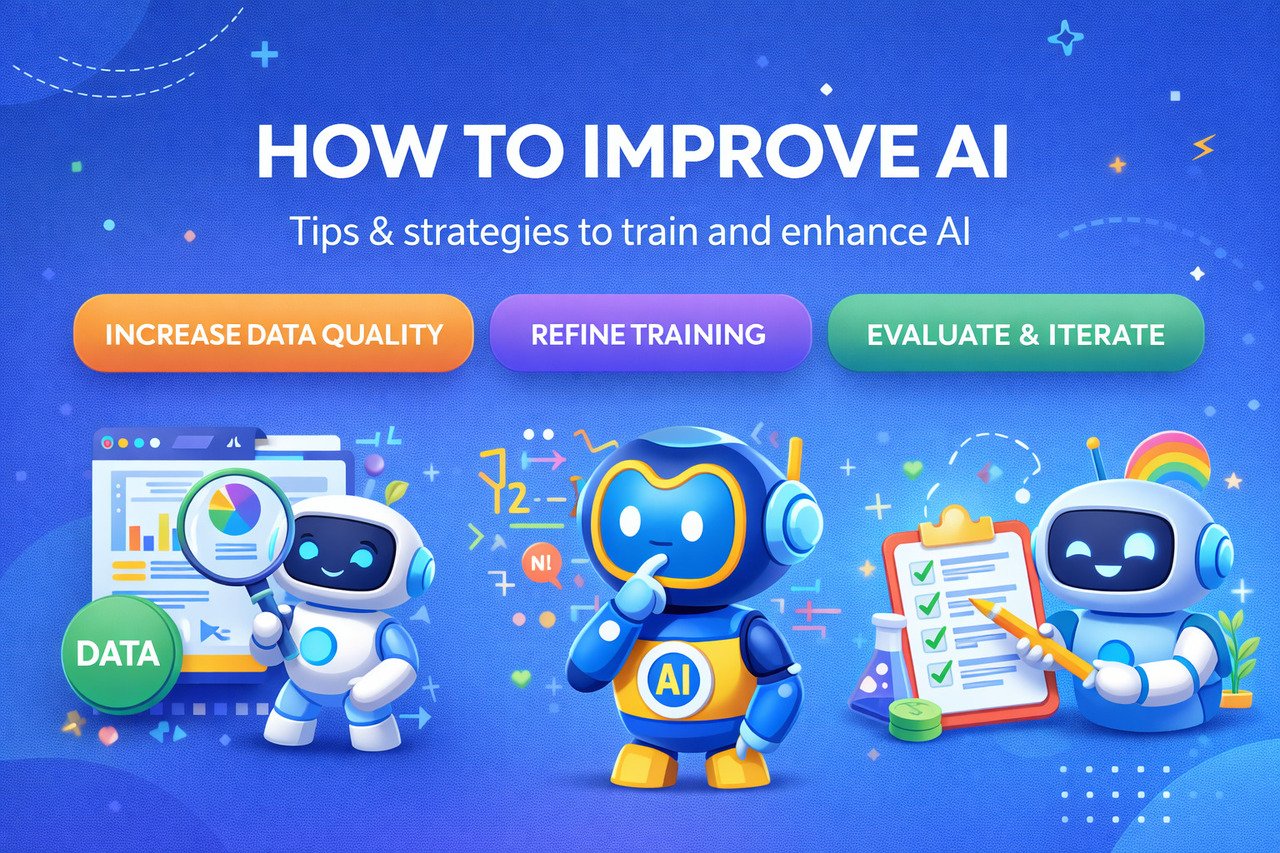
To improve AI, specialists employ superior datasets, more intelligent algorithms, and frequent evaluations. Most teams just add new training samples, correct errors in responses, and update models with new information.
Others prompt users to provide feedback or flag errors, which aids in identifying vulnerabilities quickly. AI gets stronger with real-world use and feedback.
In the following segments, discover easy actions and pal tips that anyone can test to help AI become more intelligent.
Foundational Pathways
Enhancing AI capabilities and architectures begin with solid foundational pathways. These foundational paths assist students and professionals in developing hands-on skills, assurance, and an intuition for AI. AI advances are not just about new technology, but about creating a culture of continual learning, transparent strategy, and continuous assistance.
The following steps outline a structured plan for anyone aiming to grow in AI:
-
Test your knowledge of AI fundamentals and the different types, such as narrow, general, and superintelligent AI.
-
Choose reliable resources and online courses with global recognition.
-
Establish a solid sense of what you want to learn or accomplish.
-
Allocate time each week to study, practice, and reflect.
-
At least once a month, step back and update this plan to reflect your new abilities.
1. Master Fundamentals
Start with the basics: machine learning, deep learning, and natural language processing. Learn how they power things like voice assistants or translation apps. Python and R are the most widely used languages for AI, so familiarize yourself with them.
Discover how AI algorithms operate and experiment with solving real-world problems like organizing emails or forecasting trends. Jot down a quick glossary to remind you of key concepts as you proceed.
2. Build Projects
Select projects that either resonate with yourself or align with your professional trajectory. Post your process and outcomes, whether online or in a portfolio. Collaborate with others.
It will make your work stronger and expose you to new approaches. Take feedback to correct errors or experiment and continue refining your project until you’re satisfied.
3. Refine Prompts
Experiment with alternative prompts for AI tools. See which prompts work best and jot them down for future use. Request feedback on your prompts and adjust them to elicit improved responses from the AI.
Store your favorite prompts in a file or notebook so you can recycle them.
4. Pursue Specialization
Choose an area of AI that appeals to you, such as computer vision or generative AI. Register for specialty courses or take workshops to deepen your knowledge. Engage with others in that field.
Read new research and case studies to stay up to date with changes and learn from others’ experiences.
5. Embrace Adaptation
Remain receptive to novel tools and concepts. AI evolves rapidly. Test your abilities now and again, and switch your strategy if necessary.
Join an AI hackathon or challenge and see how you do on new problems. Constantly seek opportunities to develop, and embrace each failure as an opportunity to learn.
Advanced Methodologies
Advanced AI work doesn’t just build models. It deploys intelligent techniques to verify, improve, and interpret them. Today’s top teams run stress tests, use hyperparameter tuning, and build systems to monitor how well their models outpace real-world challenges.
Data Optimization
Data optimization focuses on enhancing the quality of the data used in AI models. It involves several key practices:
-
Clean data by removing errors and outliers.
-
Use data augmentation like flips, crops, or noise.
-
Balance datasets to avoid bias.
-
Use synthetic data for rare cases.
-
Apply feature engineering to draw out key patterns.
Data augmentation boosts model strength by increasing and enriching training sets. Feature engineering transforms raw data into valuable signals, assisting AI in identifying what is most important.
Hard data pipeline projects tend to produce superior, more dependable outcomes. Data optimization is not about volume; it is about providing the AI with quality material to study.
Model Interpretability
Model interpretability is crucial in understanding how AI makes decisions. Explainable AI refers to revealing this decision-making process. Techniques like SHAP or LIME identify the most important features for every prediction.
Visuals such as heatmaps or charts allow laypeople to visualize the model’s thought process. Being explicit about making models clear builds trust. Laws in many countries now demand explainable AI, so it’s both clever and necessary.
Algorithmic Innovation
Algorithmic innovation is essential for advancing AI capabilities. Here are some notable algorithms and their applications:
To stay at the forefront of AI, consult research papers for the newest algorithms. Partner with universities to test radical concepts.
Contributing to open-source projects benefits others and attracts input that can make your work shine.
Ethical Integration
About Ethical Integration Ethical integration is about seeing how AI impacts our world, not just how it functions. When we discuss ethics in AI, we consider the impacts on individuals, equity, and confidence. AI can assist across domains, but if we don’t consider bias, privacy, and equal rights, it may do more harm than good.
-
Fairness: Make sure AI treats all people the same, no matter where they come from or who they are.
-
Transparency: Let people see and understand how AI makes choices.
-
Accountability: If something goes wrong, someone should take responsibility.
-
Privacy: Guard personal information, especially in sensitive fields like health care.
-
Bias prevention: Use diverse data and review systems to avoid unfair outcomes.
-
Oversight: Set up ethics boards or review groups to guide AI work.
-
Education: Keep learning about new risks and best practices.
To infuse ethics into AI is to translate these concepts into tangible actions. For instance, in health care, AI should not employ private data without explicit guidelines. Certain hospitals have established boards that review whether new AI tools comply with privacy and fairness standards prior to patient deployment.
For businesses, teams may establish regular audits to identify bias in AI outputs. They can produce transparent reports that display how their AI arrived at a conclusion. It’s not enough to just adhere to guidelines. AI insiders should advocate for responsible, secure AI utilization, both within their communities and publicly.
Attending AI ethics lectures and workshops cultivates a culture of concern about AI impact. By sharing our success and failure stories, we make it simple for others to learn. Discussing ethics at work and beyond enables us all to glimpse the horizon.
It brings more voices to influence AI’s direction from legislators to regular users. The more who participate in these conversations, the better and safer AI becomes for everyone.
Strategic Resources
Strategic resources how businesses grow and get ahead. AI is now one of the most important tools for this, transforming how companies operate, serve customers, and generate new concepts. For any leader, selecting and leveraging the right resources is important. Your AI big-picture plan needs to cascade from the top and shift as markets shift.
Just 40 percent of organizations have a defined AI strategy, indicating the majority are still at the beginning of their tool adoption journey.
-
Apply AI platforms and tools that assist with learning and new projects. Platforms such as TensorFlow and Microsoft Azure enable individuals to experiment with concepts and enhance their expertise. With their guides, free trials and open code, they have made it easier than ever for all of us to get started.
Easy chatbots or smart search tools can demonstrate quick wins, allowing teams to experience the potential of AI without a significant initial investment.
-
Subscribe to mailing lists and join discussion forums to gain access to a massive strategy collective. Places like GitHub, Stack Overflow, and Reddit have passionate users who post advice, code, and patches for typical issues.
These communities enable practitioners to meet collaborators, inquire, and learn by execution. Real stories from others reveal what works in the trenches, not just on the page.
-
Attend workshops and conferences to encounter leaders and learn on the spot. Conferences such as NeurIPS or local AI meet-ups allow people to hear from experts, witness new technologies and discover new ideas.
They tend to spread their talks online, which is excellent for non-travelers. Face-to-face meetings build trust and can inspire new projects.
Ethics, like bias and rules, are still central. AI must be equitable, explainable, and comply with regulations to ensure universal trust.
The Human-AI Symbiosis
Human-AI symbiosis is when humans and AI collaborate, each contributing their unique strengths. AI can crunch numbers, detect patterns, and learn from massive data in seconds. Humans, on the other hand, provide judgment, context, and a sense of what’s most important.
The most valuable AI is the AI that complements human cognition and workflow, not the AI that attempts to substitute it. This notion aligns with what numerous researchers have discovered: what’s difficult for machines is often easy for humans, and vice versa. This is Moravec’s paradox, which Yann LeCun emphasized in a keynote in Singapore.
Advanced cognition, such as strategic planning or empathetic compassion, requires minimal computing power for us, yet even rudimentary physical capabilities are hard for AI.
The ideal leverage of AI occurs when it enables humans to work smarter. For instance, in customer service, AI can propose explicitly how to say things when customers are at a loss. In design, AI accelerates drafts or assists in testing new concepts, freeing humans to concentrate on creative inspiration.
Across professions, from medicine to finance, we apply AI to sift through options, detect patterns and take quick, informed actions. This only works if AI can express its “thoughts” in ways we understand. Geoff Hinton says networks need to learn to share their inner state with humans. That fosters trust and makes collaboration tick.
Getting the best out of AI means infusing it with cross-disciplinary ideas. System 2 Deep Learning, to use Yoshua Bengio’s terminology, mixes rapid pattern discovery with deliberate reasoning. Hybrid intelligence and transfer learning are two active areas where AI learns from human skills and task history.
As the human-AI symbiosis deepens, transparent guidelines count as well, such as notifying individuals if they’re interacting with an AI. As one survey found, 89% want to know if an agent is AI or not.
Conclusion
To make real advances in AI, minor modifications are significant. Clear objectives pave the path. Robust data keeps them keen. Easy adjustments, such as novel training tricks, assist AI in learning more. Candid audits and transparent discussions keep faith fresh. Tangential examples from actual users demonstrate how groups address issues ingeniously, such as hospitals employing rapid tests to detect disease or farmers utilizing AI to monitor crops. The best results always arise from people and AI working in tandem. Test new tools and exchange tips with peers. Keep learning, keep asking, and mold AI that works for you and your world. Your next step can ignite transformation.
Frequently Asked Questions
What are the best practices to improve AI systems?
Prioritize quality data, consistent model refinement, and extensive testing. Utilize varied data sources and continuously check for biases. Use ethical principles for transparency and equity.
How does ethical integration improve AI?
Ethical integration fosters trust and minimizes risks. It ensures AI honors user privacy, isn’t prejudiced, and adheres to international ethical norms. This results in more trustworthy and widely adopted AI applications.
Why is human-AI collaboration important?
Human-AI collaboration unites human insight and inspiration with AI’s efficiency and precision. This collaboration results in improved decision-making, problem-solving, and breakthrough innovation.
What advanced methodologies enhance AI performance?
More advanced topics cover deep learning, reinforcement learning, and transfer learning. These methods assist AI in mastering complicated activities and adjusting to fresh information effectively.
Which resources are key for developing better AI?
Access to big, varied datasets and strong computing are crucial. Open-source frameworks and a talented team matter too.
How can foundational pathways boost AI progress?
Basic trails such as robust algorithms, superior data practices, and ongoing training underpin sustainable AI enhancement and growth.
What is the role of transparency in AI systems?
Transparency enables users to comprehend AI decision-making. It cultivates trust, enhances responsibility, and enables more effective oversight and governance.