As we move deeper into 2026, Artificial Intelligence is no longer a shiny bonus in marketing — it is a core infrastructure layer. Brands that treat AI as optional are already losing speed, insight, and personalization advantages.
The real opportunity isn’t just using AI tools.
It’s designing an AI-powered marketing ecosystem.
Below is a refined, strategic guide to integrating AI into your marketing in a way that drives measurable growth — not just automation.
How to Integrate AI Into Your Marketing Strategy in 2026
1. Fully Understand What AI Can Actually Do
Before implementing anything, shift from a “tool mindset” to a capability mindset.
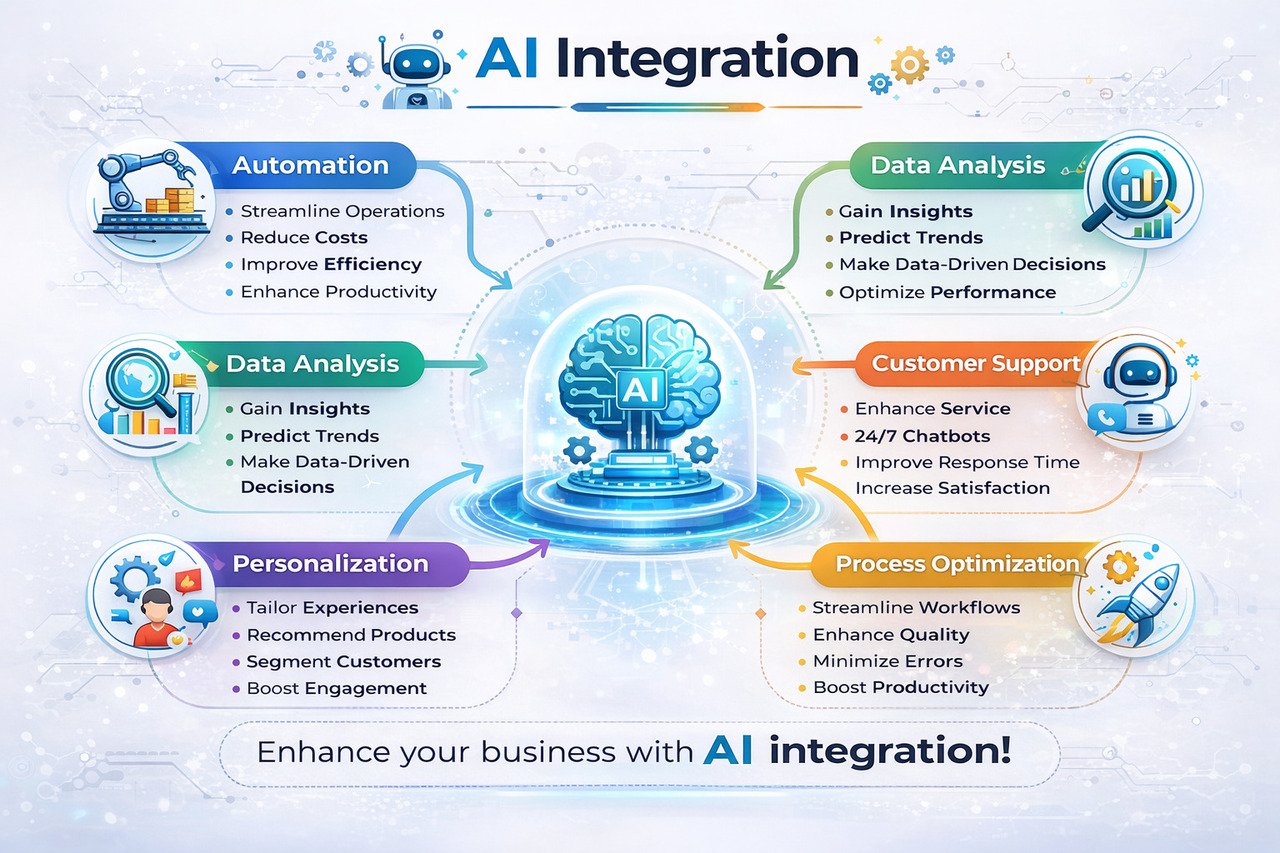
AI in marketing can power:
🔍 Advanced Data Analysis
AI processes massive datasets in seconds, identifying:
-
Hidden customer behavior patterns
-
Content performance correlations
-
Conversion bottlenecks
-
Drop-off trends
This leads to smarter decisions based on signals, not guesses.
🔮 Predictive Analytics
AI can forecast:
-
Likely customer churn
-
Future buying behavior
-
High-value leads
-
Seasonal trend shifts
Instead of reacting, you become strategically proactive.
🎯 Hyper-Personalization
AI allows:
-
Personalized email flows
-
Dynamic website content
-
Individual product recommendations
-
Behavioral retargeting sequences
This moves marketing from “audience targeting” to individual experience design.
⚙️ Automation at Scale
AI can automate:
-
Email campaigns
-
Social scheduling
-
Ad optimization
-
Lead scoring
-
Customer journey triggers
Automation frees your team to focus on strategy, creativity, and growth innovation.
2. Set Clear, Measurable Objectives
AI without objectives becomes noise.
Before implementation, define:
-
Are you aiming to increase conversions by 20%?
-
Reduce customer acquisition cost?
-
Improve engagement time?
-
Increase customer lifetime value?
Align AI With Strategy
AI should support:
-
Your brand positioning
-
Your customer journey
-
Your revenue model
-
Your growth targets
AI is not the strategy — it’s the engine powering your strategy.
3. Choose the Right Tools (Without Overcomplicating)
There are hundreds of AI tools in 2026.
Avoid stacking too many too fast.
Start With:
-
One AI-powered CRM enhancement
-
One AI email optimization tool
-
One AI ad optimization platform
-
One AI chatbot
Evaluate Based On:
-
Integration compatibility
-
Data ownership policies
-
Compliance support
-
ROI potential
Start small. Measure impact. Expand intentionally.
4. Build a Strong Data Foundation
AI is only as powerful as the data feeding it.
Focus on:
-
Clean CRM data
-
Unified customer profiles
-
Website behavior tracking
-
Purchase history
-
Email interaction data
If your data is fragmented, AI output will be fragmented.
Implement Continuous Learning Loops
Feed campaign results back into the AI system so it:
-
Learns faster
-
Refines targeting
-
Improves prediction accuracy
-
Optimizes messaging
This creates a self-improving marketing engine.
5. Personalize at Scale
Modern customers expect relevance.
AI makes personalization scalable.
Smart Segmentation
Segment audiences based on:
-
Behavioral patterns
-
Purchase timing
-
Content consumption
-
Engagement frequency
-
Intent signals
Dynamic Personalization
Use AI to deliver:
-
Personalized landing pages
-
Dynamic pricing
-
Custom product bundles
-
Individual email subject lines
The result?
Higher open rates.
Higher click-through rates.
Higher conversions.
6. Automate and Optimize in Real Time
AI doesn’t just automate — it optimizes continuously.
Automate:
-
Email sequences
-
Lead nurturing
-
Ad bid adjustments
-
Retargeting flows
-
Content distribution
Real-Time Optimization:
AI can:
-
Shift ad spend toward high-performing audiences
-
Adjust creative variations
-
Pause underperforming campaigns
-
Optimize timing and delivery
This means performance improves — even while you sleep.
7. Upgrade Customer Experience with AI
Customer experience is the new competitive battlefield.
AI Chatbots & Virtual Assistants
Provide:
-
24/7 instant support
-
Guided product recommendations
-
Order tracking
-
FAQ handling
-
Lead qualification
When trained properly, AI assistants can:
-
Increase conversion rates
-
Reduce support costs
-
Improve satisfaction scores
Continuous Feedback Integration
Feed customer interactions back into the system to:
-
Improve messaging tone
-
Identify common objections
-
Detect product gaps
-
Refine targeting
8. Stay Ethical, Transparent, and Compliant
As AI grows, so does scrutiny.
Prioritize:
-
Data privacy compliance
-
Clear opt-ins
-
Responsible automation
-
Bias monitoring
-
Transparent AI usage policies
Customers trust brands that:
-
Explain how data is used
-
Give control over personalization
-
Avoid manipulative tactics
Ethical AI builds long-term loyalty.
9. Monitor, Measure, and Adapt
AI is not “set and forget.”
Track:
-
Conversion rate changes
-
Engagement metrics
-
Customer lifetime value
-
ROI improvements
-
Customer acquisition cost shifts
Adapt Continuously
Marketing trends shift.
AI tools evolve.
Algorithms update.
Your strategy must evolve with them.
The companies winning in 2026 are those treating AI as a living system, not a static software tool.
Strategic Framework for AI Integration
To simplify implementation, follow this 5-Phase Framework:
-
Audit – Review current marketing performance and data structure
-
Define – Set measurable objectives
-
Deploy – Introduce one high-impact AI tool
-
Optimize – Analyze and refine
-
Scale – Expand AI integration strategically
Repeat the cycle.
The Big Shift in 2026
AI is no longer about replacing marketers.
It’s about:
-
Enhancing creativity
-
Increasing precision
-
Accelerating testing
-
Reducing waste
-
Improving customer connection
The businesses that thrive will be those that combine:
Human strategy + AI execution + Ethical responsibility
Final Thoughts
Integrating AI into your marketing strategy may feel overwhelming at first. But the goal is not to implement everything overnight.
Start with clarity.
Start with one meaningful objective.
Build slowly.
Optimize continuously.
When used strategically, AI becomes more than a tool — it becomes your competitive advantage engine.
In 2026 and beyond, the question is no longer:
“Should we use AI?”
The real question is:
How intelligently are we using it?